

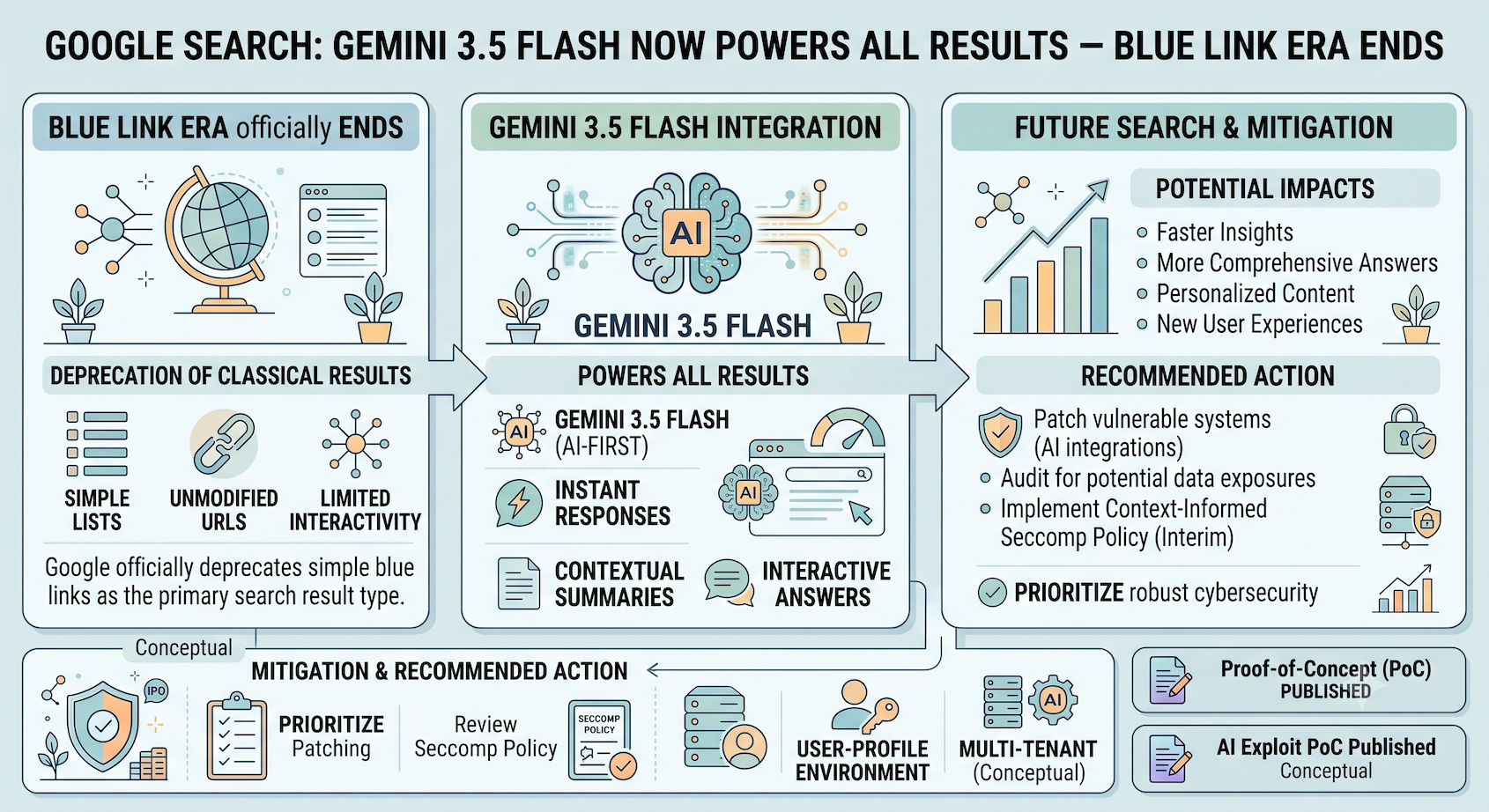
On July 10, 2026, Google officially ended the 25-year era of “ten blue links.” Search results across the platform have now been fully replaced with AI-generated summaries powered by Gemini 3.5 Flash, Google’s latest and most capable lightweight model. Traditional hyperlinks still exist — but they’re embedded as citations within AI-composed answers rather than occupying the primary result position, effectively demoting them to footnotes.
The redesigned Search experience, previewed at Google I/O 2026, is now live globally. The new interface accepts text, images, files, video, and open browser tabs as input, enabling complex conversational queries. AI agents built into Search can now monitor topics continuously and synthesize updates over time, and “generative UI” can build custom widgets and dashboards on the fly in response to queries. Gemini 3.5 Pro — a more powerful variant — is scheduled to launch July 17 and will further augment the agentic Search capabilities.
This shift marks arguably the most significant architectural change to web search since Google’s founding. For a generation of internet users, “googling something” meant scanning a list of links and choosing one to visit. That paradigm is now gone.
Sources
Commentary
This is the single biggest structural change to the open web in a decade. The blue-link model funneled traffic to publishers, news sites, and independent creators — AI summaries funnel it to Google. The SEO industry is already scrambling, but the deeper implications are about information provenance: when users get an AI-composed answer, citation visibility drops, and the incentive to produce linkable original content weakens. Security researchers who depend on public disclosure via indexed blog posts and advisories should also pay attention — if AI summaries misrepresent or flatten nuanced vulnerability disclosures, it creates dangerous signal noise at the point where defenders are trying to triage. The era of GEO (Generative Engine Optimization) is no longer coming — it’s here.