

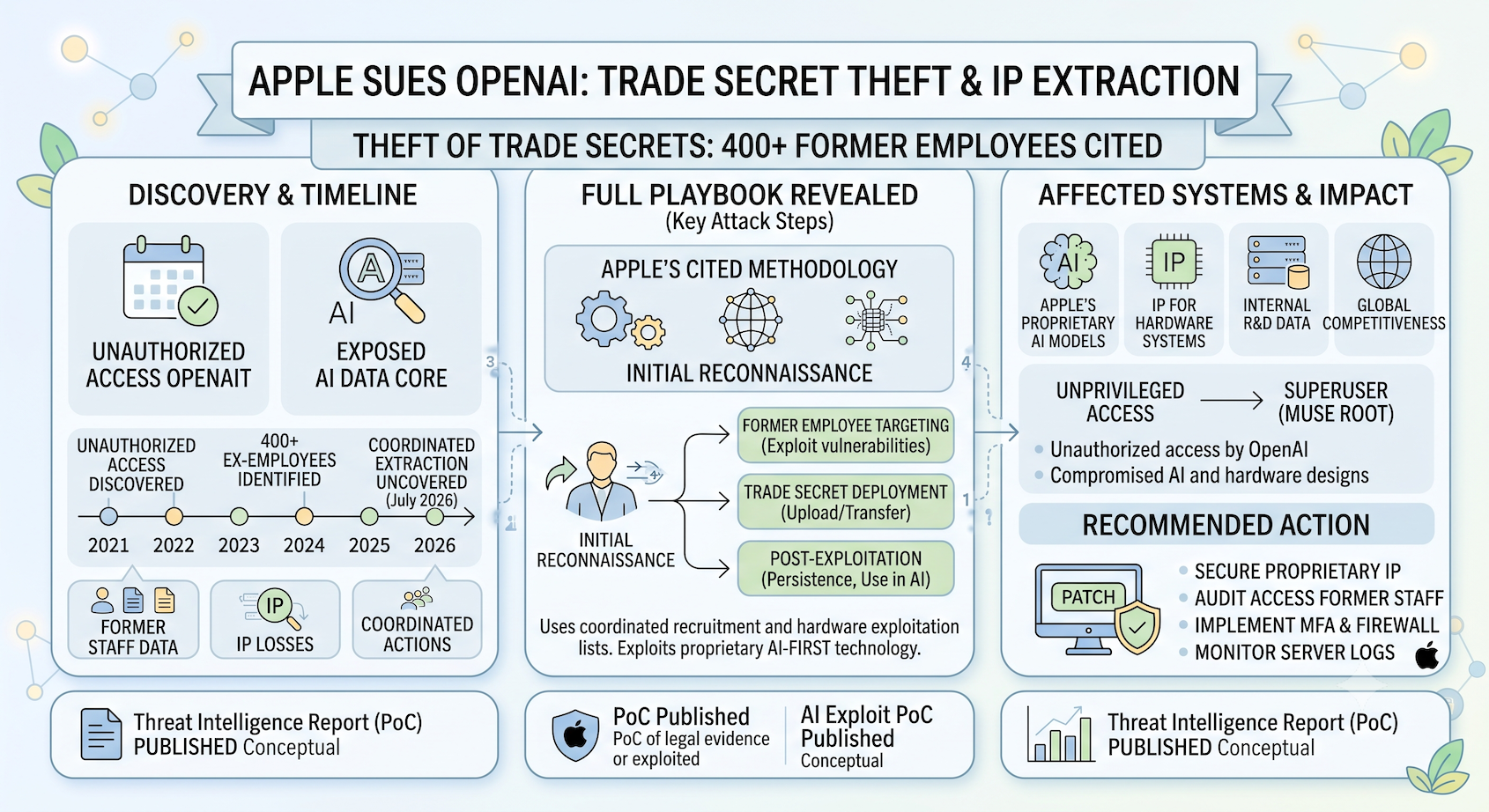
Apple filed a federal lawsuit against OpenAI on July 10, 2026 in the U.S. District Court for the Northern District of California, accusing the AI company of systematic trade secret theft. The complaint centers on more than 400 former Apple employees now at OpenAI — particularly those from Apple’s silicon engineering, on-device AI, and hardware design teams — and alleges that OpenAI coordinated the extraction of confidential technology as part of a deliberate strategy to build competing consumer hardware.
Named directly in the complaint are Tang Tan, Apple’s former VP of Product Design who became OpenAI’s Chief Hardware Officer, and Chang Liu, a former senior electrical engineer who allegedly downloaded numerous confidential hardware files from Apple’s internal network after joining OpenAI. Apple claims Tan encouraged job candidates who were still Apple employees to share confidential product information — and even to bring “actual parts” to OpenAI interviews. Apple is seeking damages and an injunction preventing OpenAI from using any of the allegedly stolen information. OpenAI responded by stating it has “no interest in other companies’ trade secrets.”
The lawsuit puts Apple’s hardware ambitions for AI directly in conflict with OpenAI’s consumer device push via its io Products subsidiary (led by former Apple design chief Jony Ive). The two companies had previously collaborated on integrating ChatGPT into Apple’s operating systems — making this a dramatic reversal.
Sources
- 9to5Mac: Apple Sues OpenAI for Trade Secret Theft
- The Guardian: Apple Challenges OpenAI’s Hardware Push in Trade Secret Lawsuit
- Forbes: Apple Sues OpenAI After Integrating ChatGPT
Commentary
This is one of the most consequential tech lawsuits in years, and it’s playing out in one of the most competitive hardware markets in AI history. The core allegation — that OpenAI systematically extracted Apple’s silicon and hardware IP through a coordinated talent pipeline — is serious even before a single line of evidence is tested in court. What it signals more broadly: the AI hardware land-grab is getting ugly. Every major AI lab is now building or planning consumer devices, and proprietary chip and design knowledge is the moat. Expect more IP litigation as the talent rotation between Big Tech and AI startups intensifies. The former Apple-OpenAI ChatGPT integration partnership makes the backstory particularly sharp — Apple let OpenAI into the tent, and now it’s alleging OpenAI used that access as cover.