

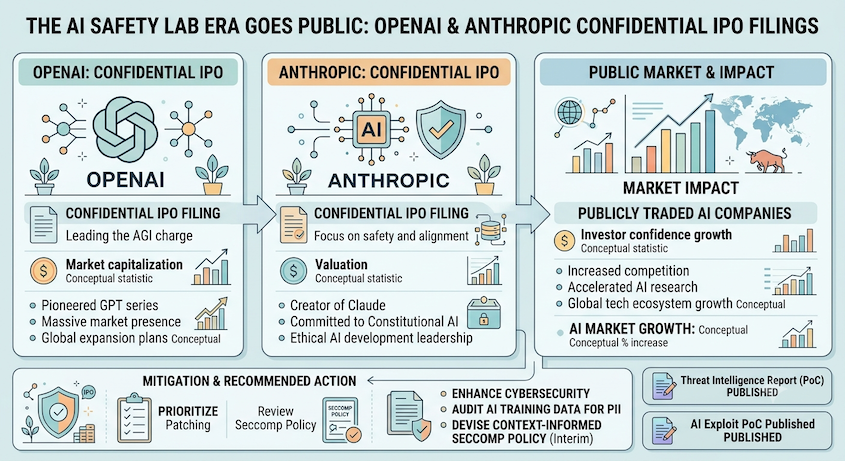
The two most prominent AI safety labs are simultaneously preparing to go public. OpenAI confidentially filed a draft S-1 registration statement with the SEC on June 8, 2026, at a current private valuation of approximately $852 billion — though CEO Sam Altman is reportedly targeting a $1 trillion valuation and may delay the public listing until 2027 to achieve it. Anthropic filed its Form S-1 on June 1, 2026, targeting an IPO as early as October 2026, with Goldman Sachs, JPMorgan, and Morgan Stanley in early discussions as lead underwriters. Anthropic’s last private valuation was $965 billion following a $65 billion Series H.
The financial picture for both is telling: OpenAI surpassed $20 billion in annualized revenue by end of 2025 and generated roughly $5.7 billion in Q1 2026 — but projects losses of $14 billion in 2026 and doesn’t expect profitability until around 2030. Anthropic’s annualized revenue run rate reached approximately $47 billion by May 2026, driven largely by Claude Code in the B2B market; it expects profitability around 2028. Meanwhile, OpenAI’s safety chief Johannes Heidecke departed during a reorganization that folded safety functions into the research division — a structural shift that will attract significant scrutiny from public market investors.
Both IPOs represent a structural turning point for the AI industry: safety-focused labs, built with mission-driven governance and unusual nonprofit structures, are now becoming publicly traded companies answerable to shareholders.
Sources
- The Motley Fool: Sam Altman Waiting for $1 Trillion OpenAI Valuation
- The Motley Fool: Anthropic — The Next Mega IPO
- Forbes: OpenAI vs. Anthropic IPO Comparison
Commentary
The AI safety lab IPO moment deserves more scrutiny than it’s getting. OpenAI folding its safety function into research — right as it files to go public — is a governance red flag that shareholders, regulators, and AI policy watchers should be watching closely. Public markets reward growth and margins; they don’t historically reward deliberate caution or pace constraints. The mission tension baked into both companies — “we exist to build safe AI for humanity, and also to maximize returns for investors” — gets significantly harder to resolve under quarterly earnings pressure. Whether the IPOs actually happen in 2026 or slip to 2027 matters less than what they signal: the AI industry is entering its financialization phase, and the incentive structures are about to get a lot more conventional.