

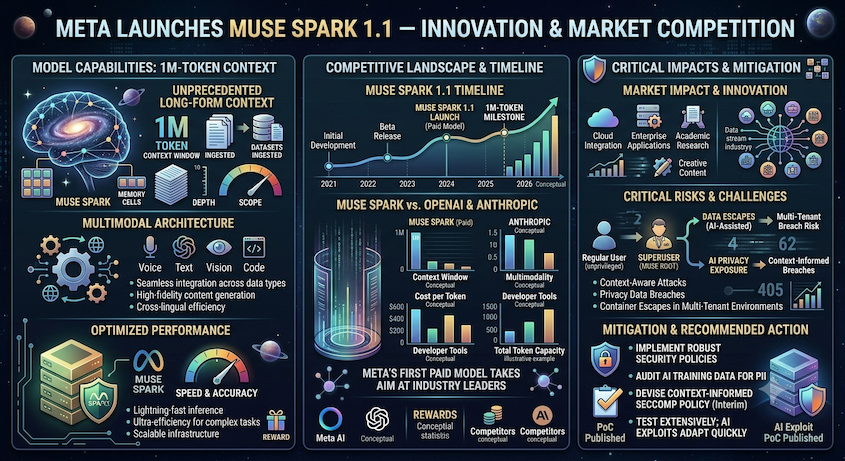
Meta Superintelligence Labs launched Muse Spark 1.1 on July 9, 2026 — its first commercially priced AI model and a direct shot at OpenAI and Anthropic’s enterprise products. The multimodal reasoning model is purpose-built for agentic tasks: coding, tool use, computer interaction, and long-horizon planning across applications and services with minimal human input. It features a 1-million-token context window and can function as both an orchestrating agent and a subagent within larger AI pipelines.
The launch came alongside a public preview of Meta’s Model API, priced at $1.25 per million input tokens and $4.25 per million output tokens, with $20 in free credits for new users. Consumer access is available free in “Thinking” mode via the Meta AI app and meta.ai. Mark Zuckerberg highlighted Muse Spark 1.1 as aggressively priced against comparable frontier models, particularly in agentic coding and enterprise contexts. Internally, Meta is also reportedly training a model codenamed “Watermelon” that has already matched GPT-5.5 benchmarks.
Source: DataCamp | MLQ.ai | Ghacks
Commentary: Meta’s entry into the paid API market is significant. The company has been distributing AI models for free to build developer mindshare, but Muse Spark 1.1 signals a monetization pivot — and at $1.25/$4.25 per million tokens, it’s positioned to undercut OpenAI and Anthropic on price while competing directly on capability. The 1M-token context window makes it genuinely useful for the kind of long-horizon agentic work that enterprise customers actually need.
What makes this more interesting is the timing. GPT-5.6 launched the same day. Two flagship AI model releases from the two largest AI companies on the same day suggests the race is accelerating, and both companies are betting big on agentic workflows as the next battleground. If Meta’s pricing sticks, it will put real pressure on OpenAI’s API pricing model.