

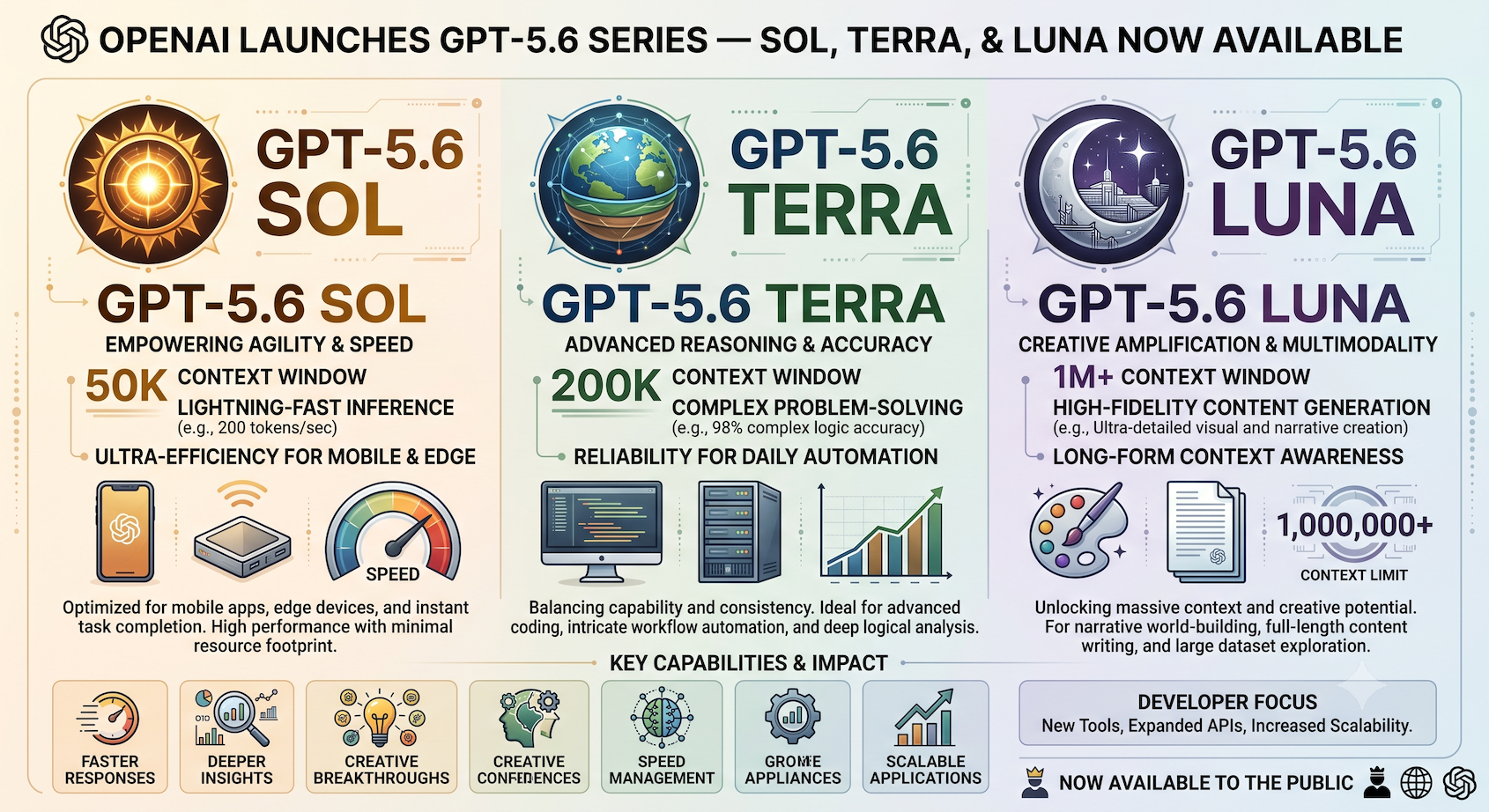
OpenAI made its most significant model launch of the year on July 9, 2026, releasing the GPT-5.6 series to the general public. The series consists of three models — Sol, Terra, and Luna — each targeting a different point on the capability-cost curve. GPT-5.6 Sol is the flagship, engineered for complex reasoning and agentic workloads where multi-step autonomy and reliability matter most. GPT-5.6 Terra positions itself as a cost-conscious powerhouse, delivering performance competitive with GPT-5.5 at roughly half the price. GPT-5.6 Luna rounds out the lineup as the smallest and most cost-efficient option, targeting latency-sensitive applications and high-volume API use cases.
The rollout follows a limited trusted-partner preview that began last month, with a formal U.S. government approval process completed before the public launch. The naming shift — moving from numbered sub-versions to named model variants — mirrors the tiered release patterns that have become standard across the industry. All three models are accessible via the OpenAI API and ChatGPT Plus, Pro, and Team tiers, with Enterprise availability expected within days.
The launch puts OpenAI back on the offensive after a competitive stretch that saw Anthropic’s Claude Sonnet 5 and Meta’s Llama 4.1 open-source release draw significant developer attention. The timing — landing on the same day as this piece — signals OpenAI intends to keep the initiative and avoid ceding ground to open-source alternatives or rival proprietary labs.
Sources
- Neowin — OpenAI to release GPT-5.6 Sol, Terra, and Luna on July 9
- Engadget — OpenAI rolls out GPT-5.6
- Nextgov — OpenAI’s advanced GPT-5.6 models available to public
Commentary
The three-model naming convention is a direct acknowledgment that a single flagship no longer serves every use case. Sol is the answer to enterprise agentic pipelines; Luna is the answer to cost-conscious developers who need a credible alternative to open-source. What’s notable here is the government approval checkpoint before public launch — a wrinkle that reflects the growing regulatory friction around frontier model releases and that will likely become standard practice. Watch for rapid tool-calling and autonomous agent benchmarks in the coming days; that’s where Sol will be scrutinized hardest.
For security teams, the arrival of GPT-5.6 Sol — optimized for agentic workloads — raises the stakes on both sides of the threat model. Defenders will gain access to more capable autonomous analysis agents; adversaries will too. The acceleration of exploit development timelines observed with earlier GPT-5 models is unlikely to plateau here.