

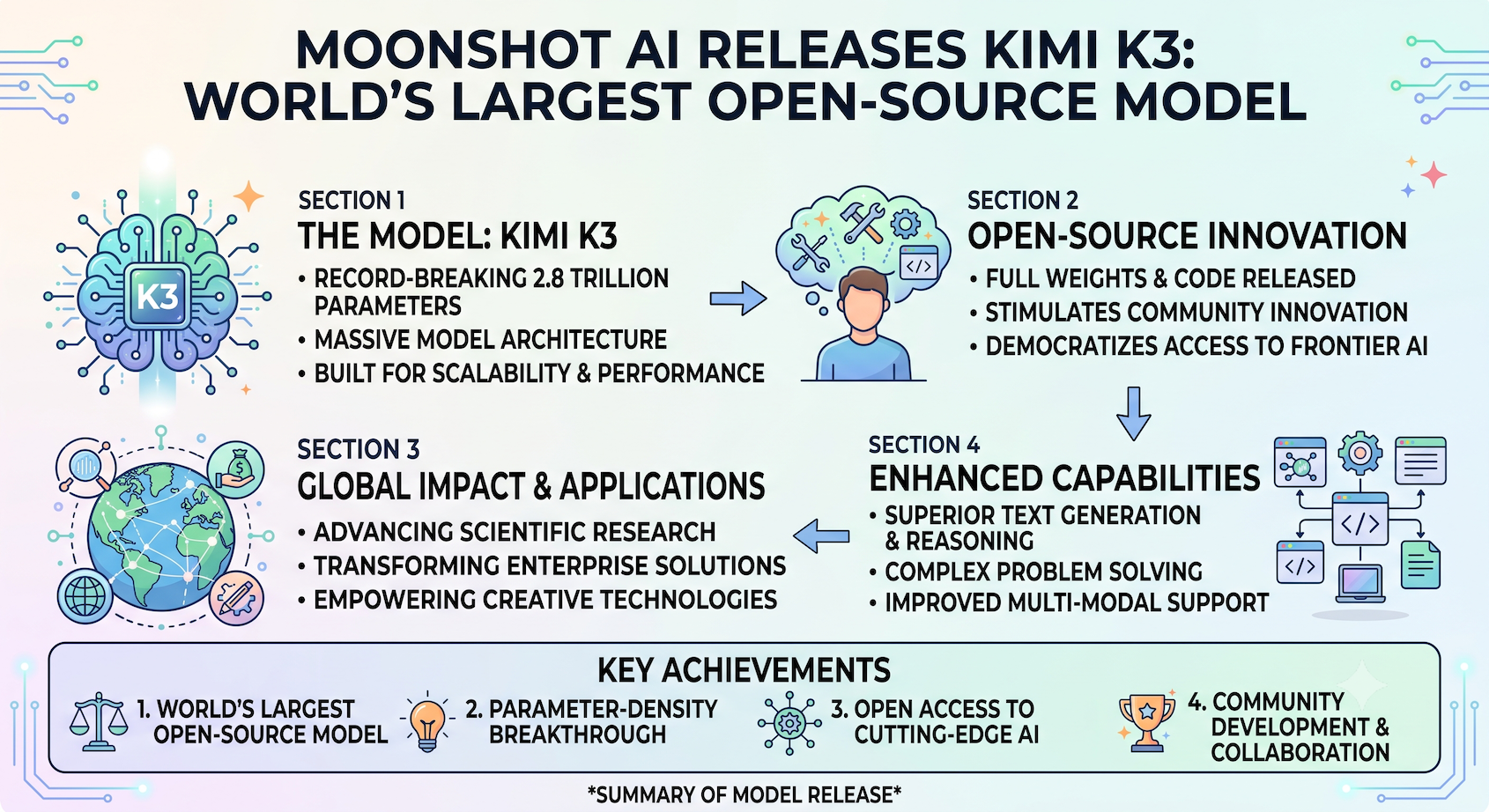
On July 16, 2026, Chinese AI startup Moonshot AI officially launched Kimi K3, a 2.8-trillion-parameter model that instantly became the largest open-source AI model in history. Built on novel Kimi Delta Attention (KDA) architecture with Attention Residuals, the model ships with a 1-million-token context window, native visual understanding, and an “always-on” reasoning mode. At release, Kimi K3 debuted in third place on the Artificial Analysis AI leaderboard — trailing only Anthropic’s Claude Fable 5 and OpenAI’s GPT-5.6 Sol — and claimed the top spot on Arena.ai’s front-end web development benchmark.
Moonshot has priced the model at $3 per million input tokens and $15 per million output tokens. Full model weights are scheduled for public release by July 27, 2026 — a commitment that, if met, will give the open-source and research communities access to the most capable openly available base model to date. The launch adds further fuel to the ongoing “Great Model Price War” that erupted in early July, which has seen output token costs drop from $25–$50 for legacy flagships to under $6 for frontier-tier models.
Source
- VentureBeat — Moonshot AI releases Kimi K3
- Tom’s Hardware — Moonshot releases 2.8 trillion-parameter Kimi K3
- Simon Willison’s Weblog — Kimi K3
Commentary
Kimi K3’s arrival matters beyond the benchmark leaderboard. A 2.8-trillion-parameter model with open weights puts serious frontier capability in the hands of anyone with sufficient compute — including security researchers, red teams, and threat actors. The dual-use implications are real: a model this capable can assist in vulnerability discovery, code synthesis, and social engineering at a scale that was, until very recently, gated behind API access. Western labs will need to respond quickly, both on capability and on thinking carefully about how open-weight releases at this scale interact with the evolving AI security threat surface.
Moonshot’s rise also signals that China’s AI labs are no longer catching up — they are competing at the frontier. This has geopolitical and national-security implications well beyond the AI industry itself.