

Summary
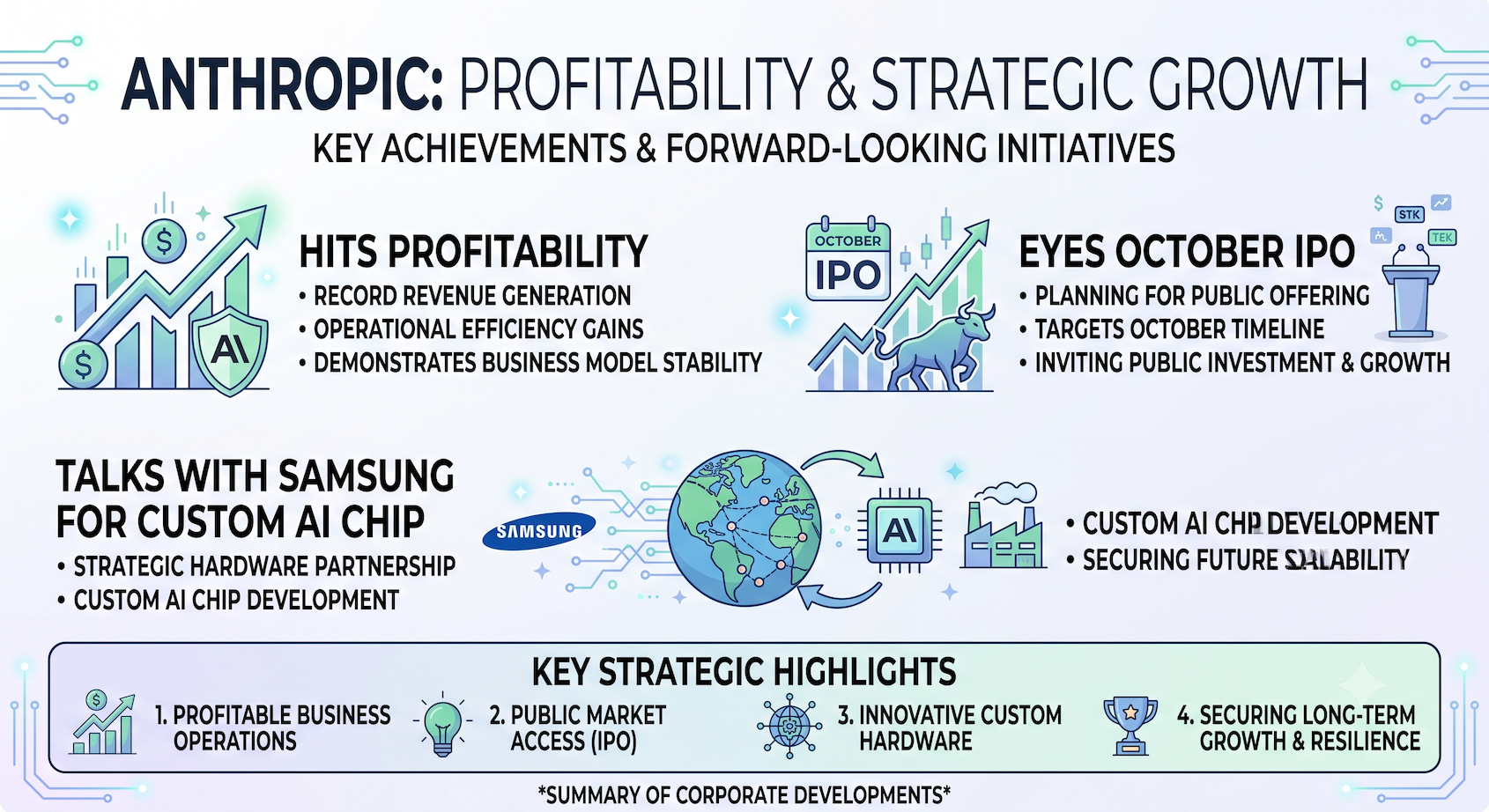
Anthropic, the AI safety company behind the Claude family of models, has reportedly reached profitability in 2026 with annualized revenue tracking toward approximately $47 billion. The company is preparing for an October IPO with a safety-and-enterprise positioning strategy, differentiating itself from OpenAI’s more consumer-facing approach. The IPO would follow closely behind OpenAI’s own confidential filing, making Q3-Q4 2026 a landmark period for AI company public offerings.
Separately, Anthropic is reported to be in active discussions with Samsung for the development of a custom AI inference chip. This mirrors moves by OpenAI, which is co-developing the “Jalapeño” chip with Broadcom, and reflects a broader industry trend of frontier AI labs vertically integrating into hardware to reduce dependence on Nvidia and manage the extraordinary compute costs associated with running large-scale inference. Custom silicon optimized for specific model architectures can deliver significant performance-per-watt advantages over general-purpose GPUs.
The combination of profitability, IPO readiness, and chip development signals that Anthropic is transitioning from a research-focused safety lab into a full-stack AI infrastructure company. The company has also been noted for its enterprise-centric go-to-market approach, with Claude increasingly embedded in large enterprise workflows through partnerships with major cloud providers and direct API contracts.
Sources
Commentary
Anthropic reaching profitability while simultaneously preparing an IPO and pursuing custom silicon is a remarkable arc for a company founded on AI safety principles. The question for the market will be whether the safety-and-enterprise brand positioning holds through the pressures of being a publicly traded company — quarterly earnings calls and shareholder expectations have a way of eroding stated missions over time. The Future of Life Institute’s 2026 AI Safety Index giving Anthropic only a C+ grade (the highest of any frontier lab) suggests there is already a gap between stated principles and observed behavior.
The Samsung chip deal talks, if they materialize, would be strategically significant: Samsung’s advanced packaging and HBM memory capabilities combined with Anthropic’s model architecture knowledge could produce inference hardware with meaningfully different performance characteristics than Nvidia-centric deployments. For the industry, more custom silicon means more infrastructure diversity, which is broadly good for resilience — but it also means more opaque compute environments that are harder to audit and regulate.