

Summary
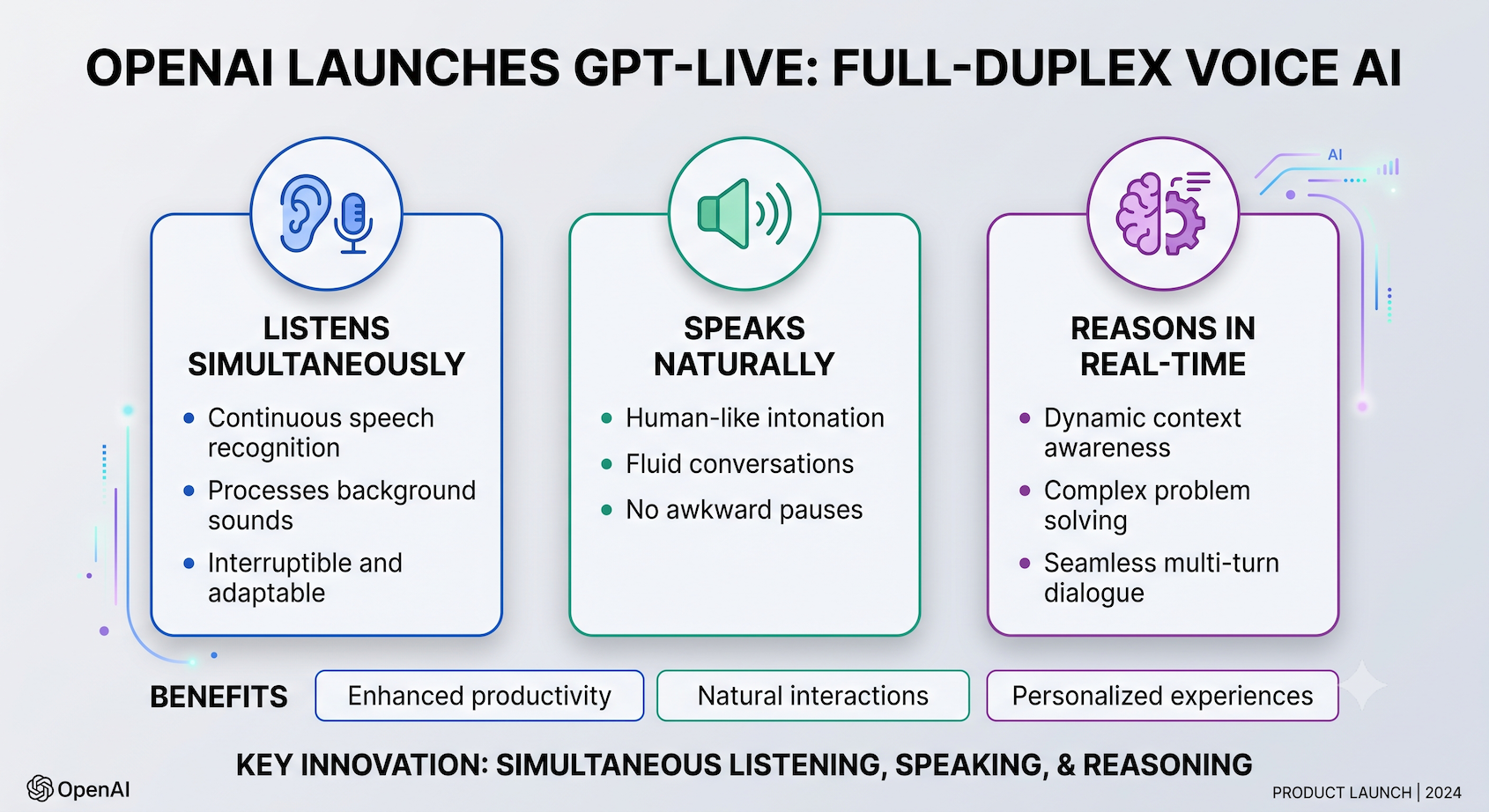
OpenAI introduced GPT-Live on July 13, 2026 — a new generation of voice AI built on a full-duplex architecture that allows the model to listen, speak, and reason at the same time. Unlike previous voice modes that required conversational turn-taking, GPT-Live maintains continuous awareness during response generation, enabling natural interruptions, dynamic topic shifts, and real-time reactions to what a user says mid-sentence.
Key capabilities include live translation with near-zero latency for bilingual conversations, integrated real-time web search during voice interactions, and multi-step reasoning while maintaining conversational flow. The model is available via ChatGPT and the API, with OpenAI citing an extensive red-teaming safety process before launch. The release arrives alongside the company’s confidential IPO filing and ongoing GPT-5.6 series rollout.
The voice AI space is increasingly competitive: Google Gemini Live and Anthropic Claude Voice both offer similar functionality, but OpenAI is claiming superior latency and simultaneous dual-channel reasoning quality. The practical enterprise use cases include real-time customer support translation, voice-driven workflow automation, and interactive document review — all with a conversational model that doesn’t require the user to wait for a response before continuing to speak.
Source
Build Fast With AI — AI News Today: July 13, 2026
AI Weekly — GPT-Live Launch Coverage
Commentary
Full-duplex voice AI is a genuinely meaningful architectural shift. The current turn-based model creates an uncanny valley effect — the AI listens passively until it detects an end-of-turn signal, then responds. Full-duplex changes that entirely: the model can react to mid-sentence interruptions, pick up on tonal cues in real time, and maintain context across overlapping speech in ways that feel substantially more natural.
The security angle is worth watching closely. Real-time web search during voice interactions means GPT-Live is processing live external content mid-conversation — a potential prompt injection surface that’s harder to audit than text interactions. OpenAI’s red-teaming claims are notable but unverifiable; the safety challenges of a full-duplex reasoning system are meaningfully different from text-based models, and the failure modes will emerge at scale. The live translation capability also opens enterprise use cases in sensitive contexts — legal, medical, government — where the stakes of a model hallucination or injection are high.