

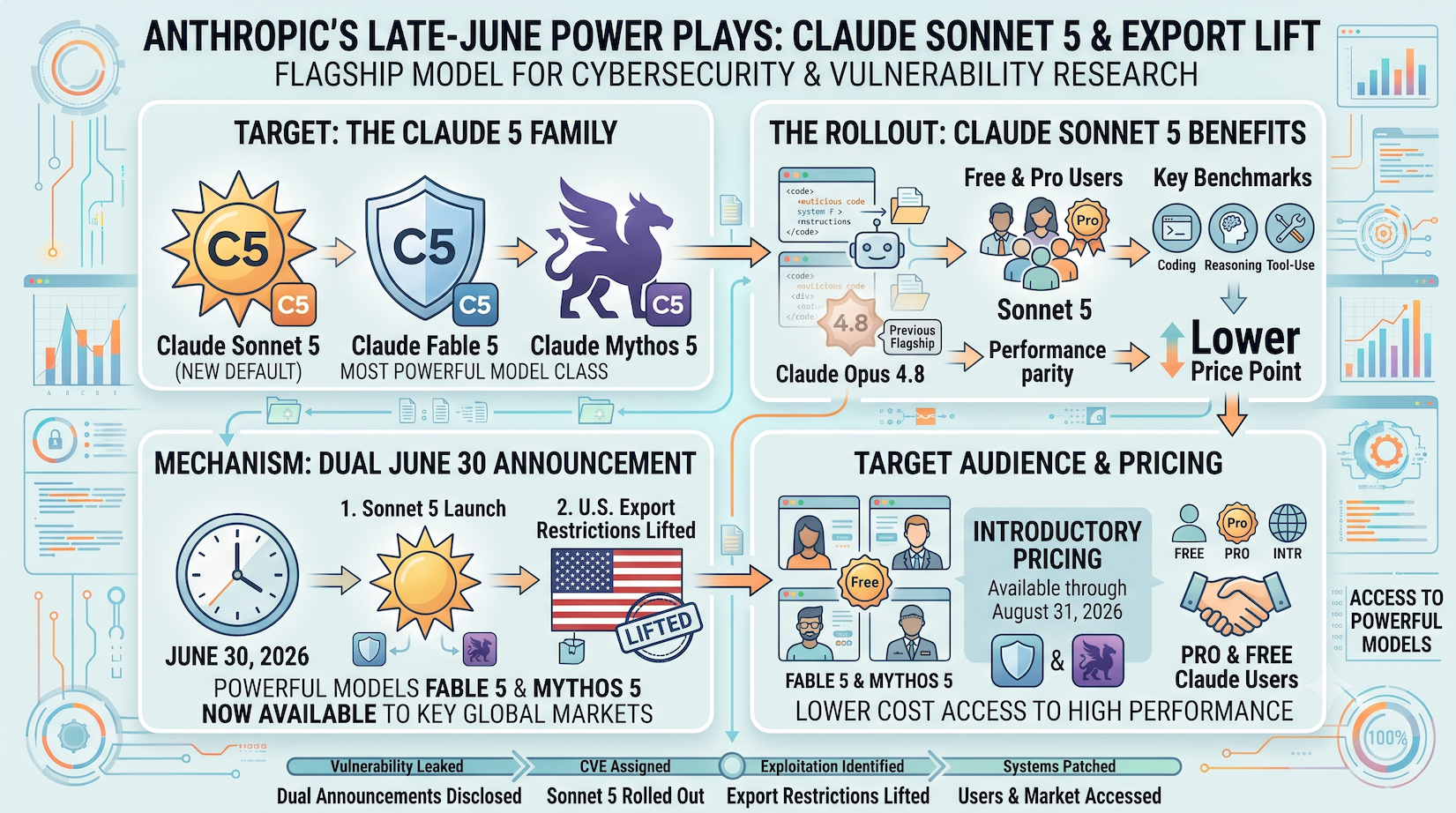
Anthropic closed out June with a one-two punch: the launch of Claude Sonnet 5 on June 30 and the simultaneous lifting of U.S. export restrictions on its most powerful models, Claude Fable 5 and Mythos 5. Sonnet 5 is now the default model for all Free and Pro Claude users, delivering performance close to the flagship Opus 4.8 on coding, reasoning, and tool-use benchmarks at a significantly lower price point, with introductory pricing available through August 31, 2026.
Fable 5 and Mythos 5, originally launched on June 9, were pulled from global availability just three days later when the U.S. Department of Commerce imposed emergency export controls over national security concerns — specifically related to their cybersecurity capabilities. On June 30, the restrictions were officially lifted, and Anthropic announced that global access to Fable 5 would begin rolling out across Claude Platform, Claude.ai, Claude Code, and Claude Cowork starting July 1.
Source
Anthropic Blog · CIO · InfoWorld
Commentary
The Fable 5 export saga is the clearest signal yet that frontier AI models are entering the same regulatory territory as dual-use military technology. The fact that the U.S. government pulled export access to AI models based on their cybersecurity capabilities — not their biology, chemistry, or weapons design potential — tells you where the national security establishment sees the sharpest near-term risk from AI.
For the AI market, Sonnet 5 is the more immediately impactful release: a near-Opus-tier model at a fraction of the cost effectively resets the price-performance curve and puts pressure on OpenAI, Google, and the open-source community. For the security community, the more interesting question is what Fable 5 and Mythos 5 can actually do in offensive security contexts that prompted a government intervention — and whether the restrictions being lifted means those capabilities were overstated, or that adequate safeguards were negotiated behind the scenes.