

Summary
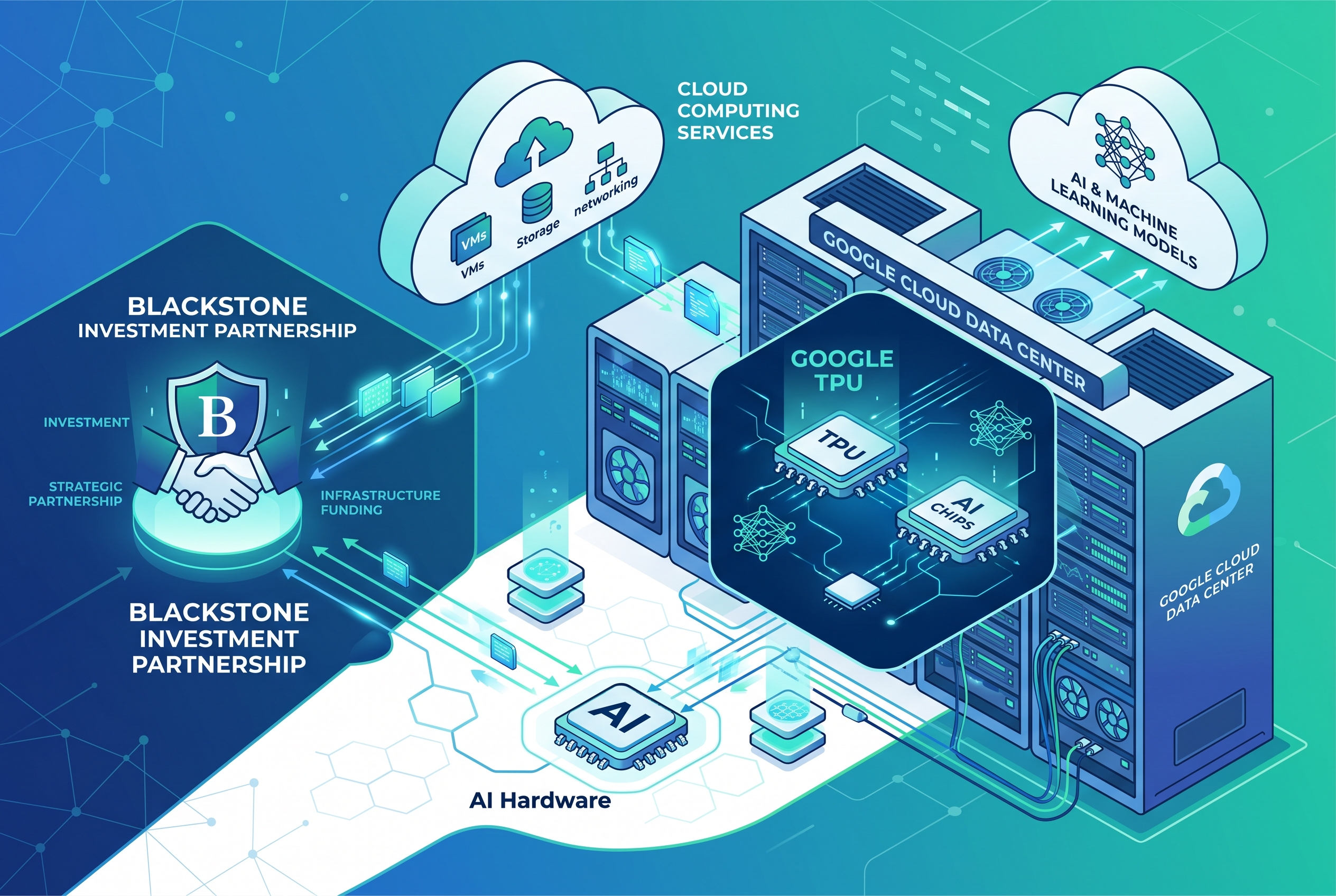
Google and Blackstone announced a joint venture today to create a new AI cloud company, with Blackstone committing an initial $5 billion. The venture will offer Google Cloud’s Tensor Processing Units (TPUs) as a compute-as-a-service product, giving customers direct access to the custom AI chips that power Google’s own models and services including Gemini.
The new company expects to bring its first 500 megawatts of data center capacity online next year. Google will supply hardware (including TPUs), software, and services, while Blackstone provides the capital and infrastructure investment. Customers will be able to access cloud TPUs both through the new venture and through Google Cloud directly.
The move has been anticipated by industry observers for years. Google already has major TPU agreements with Anthropic (approximately one million chips) and Meta, but this venture marks the first time Google is systematically commercializing TPU access at scale through a dedicated entity backed by one of the world’s largest alternative asset managers.
Source
Blackstone Official Announcement | PYMNTS Coverage | Wall Street Journal
Commentary
This is a major strategic move on two fronts. First, it’s Google formally entering the AI compute marketplace as a hardware vendor, not just a cloud provider. TPUs have long been Google’s secret weapon — purpose-built silicon that’s more efficient than NVIDIA GPUs for certain AI workloads. Making them broadly available through a dedicated entity changes the competitive dynamics of the AI infrastructure market.
Second, the Blackstone partnership brings serious financial firepower. $5 billion upfront with 500MW of capacity planned signals this isn’t a pilot — it’s a full-scale assault on NVIDIA’s dominance in the AI compute rental market. For AI labs and enterprises that have been locked into NVIDIA’s ecosystem due to lack of alternatives, this creates a credible second option. The question is whether the software ecosystem around TPUs can match CUDA’s maturity — but Google has years of internal production use proving the hardware works at scale.