

Summary
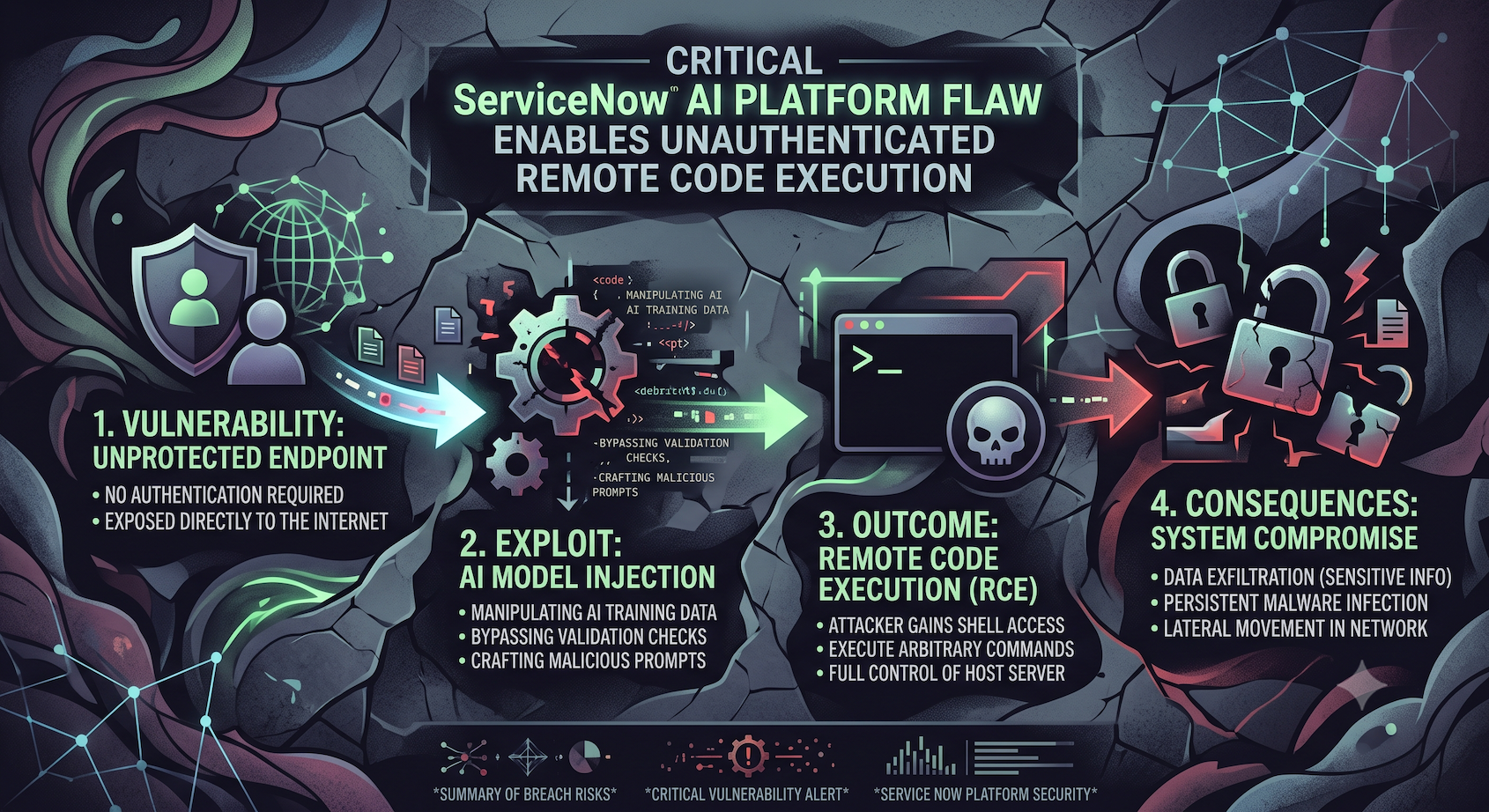
A critical vulnerability in the ServiceNow AI Platform was disclosed on July 14, 2026, enabling unauthenticated remote code execution against affected instances. The flaw affects the AI Platform component, which has seen rapid enterprise deployment as organizations integrate ServiceNow’s agentic workflow capabilities into IT operations, HR, and security management.
The vulnerability allows a remote, unauthenticated attacker to execute arbitrary code without any prior authentication or user interaction. ServiceNow’s platform is widely deployed across Fortune 500 companies, government agencies, and managed service providers. The company has released patches and is urging immediate updates to affected instances. The disclosure follows the pattern of AI-adjacent enterprise platforms becoming high-value targets — the Langflow vulnerability (CVE-2026-55255) was exploited by the JADEPUFFER autonomous ransomware operation just weeks ago.
ServiceNow instances typically sit at the center of enterprise IT operations with deep integrations into Active Directory, CMDB, ticketing, and increasingly with AI agents that have broad tool-use capabilities. An unauthenticated code execution vulnerability in that context is not just a server compromise — it is a potential pivot point into everything the platform touches.
Source
Check Point Research — July 13 Threat Intelligence Report
Commentary
Unauthenticated RCE on a platform that orchestrates enterprise IT operations is as severe as vulnerabilities get from an impact perspective. Standard indicators like impossible travel or failed logins simply don’t fire when an attacker achieves code execution directly. The attack surface compounds when you consider that ServiceNow’s AI Platform often has OAuth integrations with every other major SaaS product in the enterprise stack.
This is the second major AI platform pre-auth RCE in as many months, following Langflow. The pattern is clear: enterprises are rushing AI workflow platforms into production without the security scrutiny applied to traditional deployments, and attackers are finding the gaps. Security teams should be treating AI workflow platforms as tier-1 critical attack surface — not productivity tools — and ensuring they’re covered by their vulnerability management SLAs accordingly.