

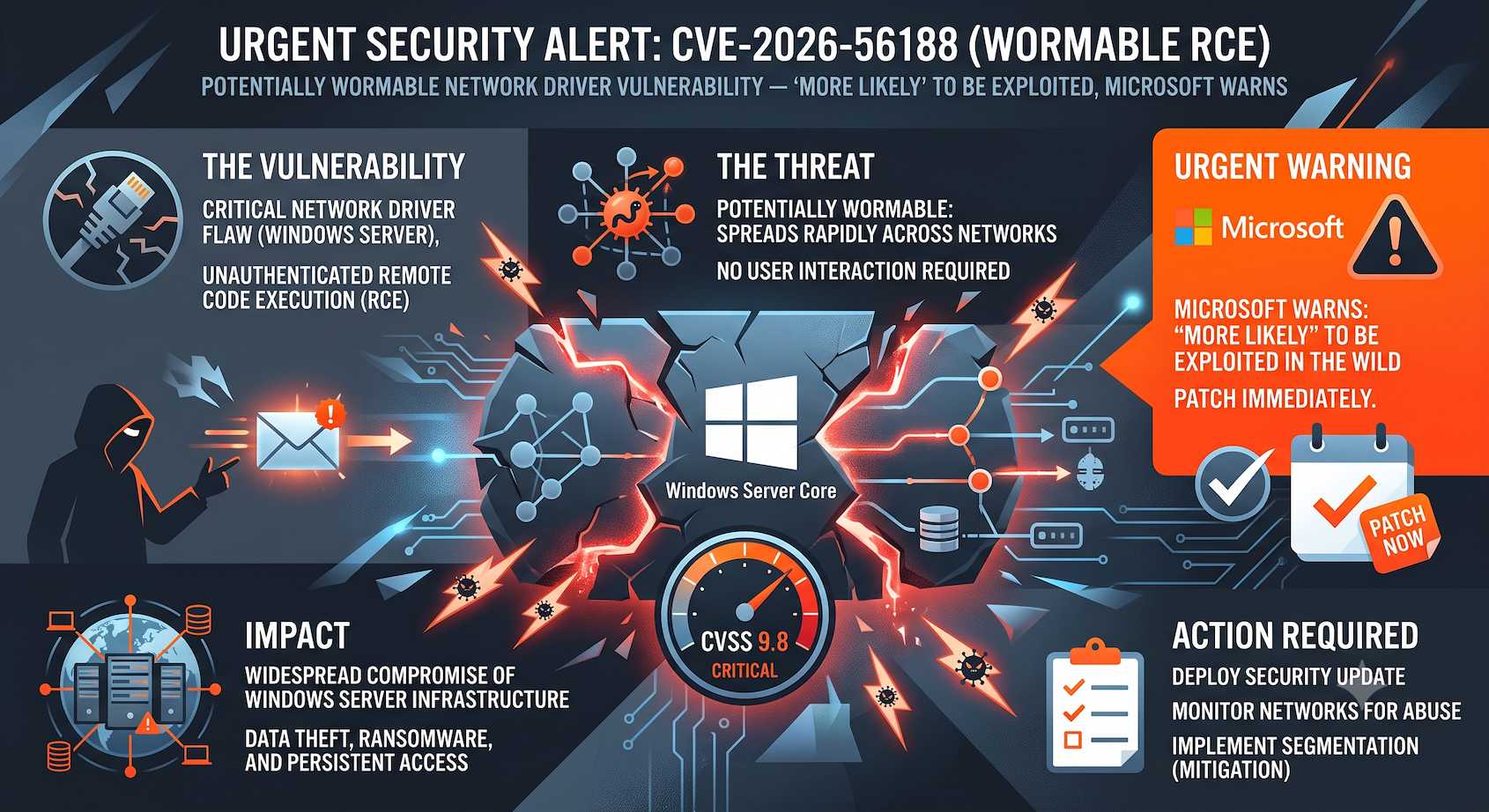
Among the 622 flaws patched in Microsoft’s July 2026 Patch Tuesday, security researchers have flagged CVE-2026-56188 as deserving special urgency. This critical remote code execution vulnerability in the Windows Server Network driver carries a CVSS 3.1 score of 9.8 and is described as a race condition (CWE-362) that allows an unauthenticated, remote attacker to execute arbitrary code over a network without any user interaction and with low attack complexity. Microsoft has assessed the exploitation likelihood as “More Likely” — the company’s highest confidence tier short of confirmed in-the-wild exploitation.
Security researchers have characterized CVE-2026-56188 as potentially wormable due to its network-accessible attack vector, lack of authentication requirements, and the ubiquity of the affected Windows Server Network driver across virtually every supported Windows Server and client deployment. While a complete, reliable worm chain has not yet been publicly demonstrated, the combination of CVSS 9.8, “More Likely” exploitation rating, and zero-interaction requirements historically precede active worm campaigns. All supported Windows Server versions — including Server 2025, 2022, 2019, and 2016 — are affected, as are Windows 11 and 10 client systems.
Source
- CrowdStrike — July 2026 Patch Tuesday Analysis
- NVD — CVE-2026-56188
- Windows Forum — CVE-2026-56188 Thread
Commentary
The last time Microsoft issued a “More Likely” assessment for a wormable network driver flaw, defenders had days — not weeks — before exploit code appeared in the wild. CVE-2026-56188 has all the hallmarks of a vulnerability threat actors will invest in weaponizing: it requires no authentication, no user interaction, targets a universally present component, and runs over the network. If a reliable exploit chain is built, it could propagate laterally through enterprise networks at machine speed.
Organizations that have not yet applied July 2026 Windows updates should prioritize them immediately, with particular attention to internet-facing Windows Server instances and those in flat network segments. Network segmentation and egress filtering on Windows Server-to-Server SMB/RPC traffic can reduce blast radius if exploitation begins. Assume a working exploit is coming — patch before it arrives.