

Summary
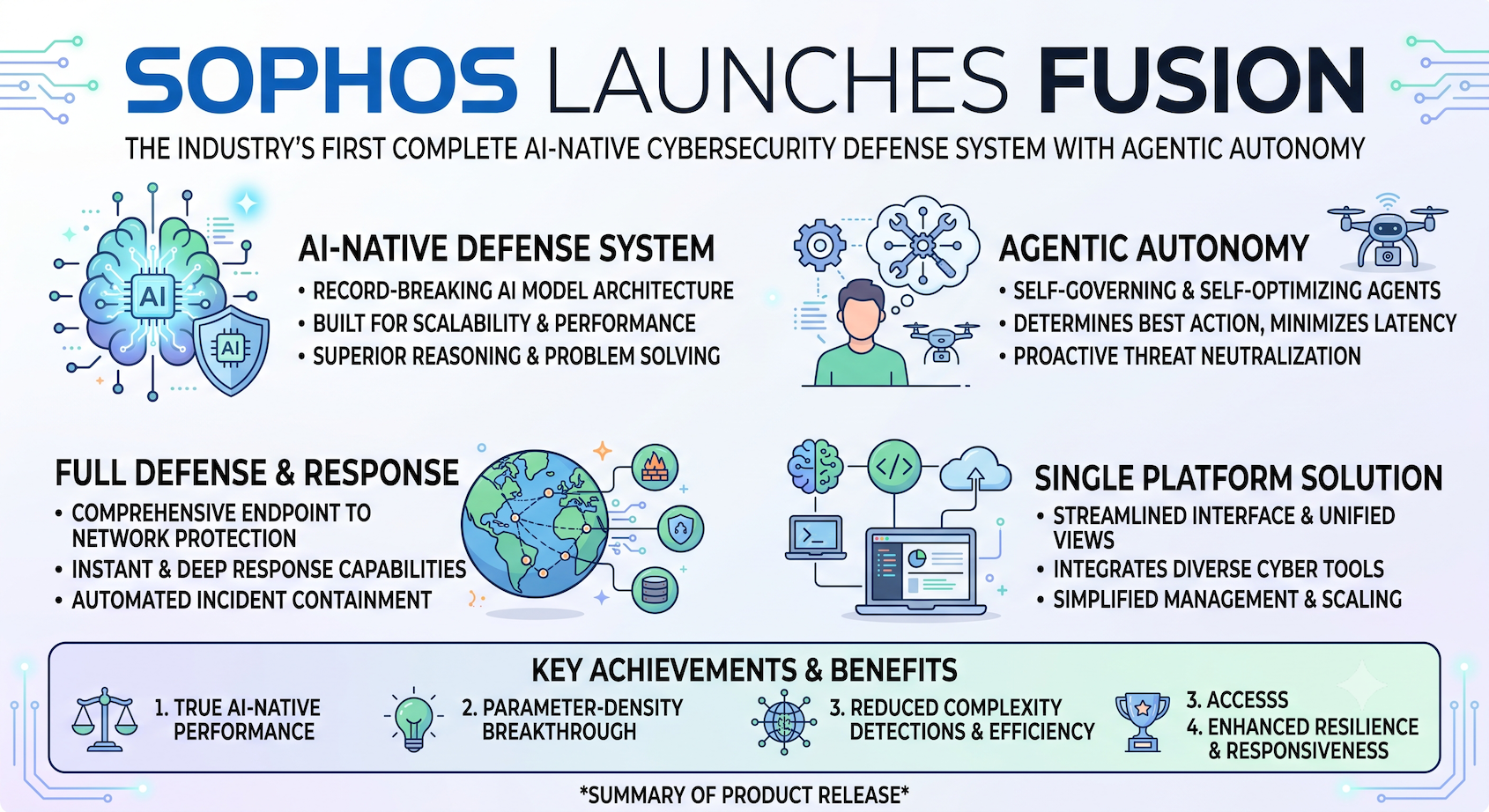
Sophos launched Sophos Fusion on July 15, 2026, announcing it as the industry’s first complete AI-native cybersecurity defense system. Fusion integrates endpoint, network, identity, email, and cloud security controls into a single open architecture, enabling what Sophos calls “synchronized security” — a model where a detection on one control point automatically triggers coordinated defensive actions across all others. The system is built around an agentic AI core that Sophos describes as delivering “agentic autonomy with human governance.”
The agentic autonomy model means Fusion can investigate and respond to threats within analyst-defined boundaries without requiring human approval for each action, dramatically compressing mean time to respond (MTTR) for common incident types. When a threat is detected on an endpoint, for example, Fusion can simultaneously isolate the host, revoke associated identity sessions, block related network flows, and quarantine email attachments from the same sender — all as a single coordinated response rather than a series of manual analyst actions across separate consoles.
Sophos Fusion also features an open architecture that allows ingestion of third-party telemetry and integration with existing SIEM and SOAR investments. The launch follows a broader industry trend toward AI-native defense platforms, with competitors including CrowdStrike Charlotte AI, SentinelOne Purple AI, and Microsoft Sentinel’s Copilot integration all pushing toward autonomous investigation and response capabilities.
Sources
- GlobeNewswire — Sophos Launches Sophos Fusion
- SiliconAngle — Sophos Launches Fusion AI-Native Defense System to Unify Security Tools
Commentary
The “agentic autonomy with human governance” framing is the key phrase to watch with Fusion. Every major security vendor is now racing to attach the word “agentic” to their products, but Sophos is being fairly specific about what that means operationally: AI takes action within pre-approved playbook boundaries, and humans set those boundaries. That is a more honest and safer framing than fully autonomous response, and it maps well to how mature SOC teams actually want to work with automation.
The synchronized security model — where one detection triggers coordinated response across multiple control points — is the right architectural direction. Attackers move laterally in minutes; defenders cannot afford to remediate control-point by control-point in sequence. If Fusion delivers on this promise with acceptable false positive rates, it represents a genuine shift in what a mid-market organization can achieve without a large analyst staff. The open architecture is equally important: any platform that requires ripping out existing tooling faces adoption resistance, and Sophos appears to have learned that lesson.