

Summary
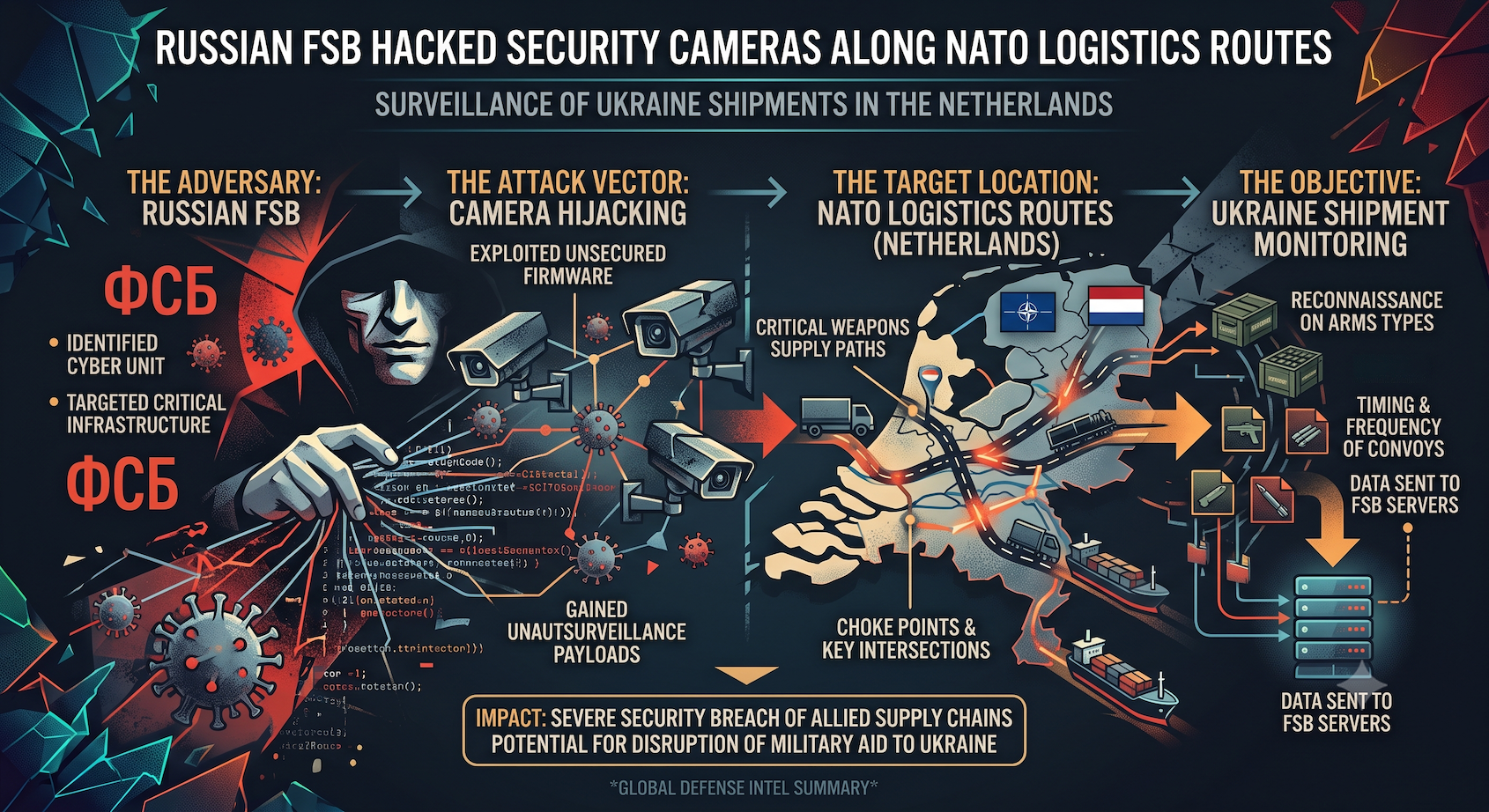
Russian intelligence operatives linked to the FSB reportedly hacked into security cameras positioned along military logistics routes in the Netherlands, using the footage to surveil and monitor weapons shipments destined for Ukraine. The operation involved compromising commercially operated and government-adjacent camera networks that happened to overlook rail yards, highways, and transit corridors used to move NATO military aid eastward. Dutch officials confirmed the intrusion as part of a broader pattern of Russian intelligence operations targeting NATO member logistics infrastructure.
The camera compromise is distinct from the previously reported FSB Center 16 router attacks — this operation focused specifically on intelligence collection rather than disruption, demonstrating the dual-track nature of Russian cyber operations: persistent disruption campaigns alongside quieter intelligence-gathering operations targeting the physical logistics of Western military support. The Netherlands has been one of the primary transit hubs for military equipment flowing from Western Europe to Ukraine, making it a high-value surveillance target.
The incident highlights a significant gap in critical infrastructure security: civilian camera networks, which are often managed by municipalities, transportation authorities, or private operators with minimal cybersecurity investment, are providing adversaries with persistent real-time intelligence on sensitive military movements. Attribution to FSB was made by Dutch intelligence services based on tooling and infrastructure overlap with known Russian state-sponsored operations.
Sources
Commentary
This operation is a reminder that cyber espionage and kinetic conflict are no longer separate domains. Hacking cameras to watch weapons shipments in real time is a direct force multiplier for physical interdiction operations — it tells adversaries what is moving, when, and by what route. The civilian infrastructure being used as the surveillance platform is the critical vulnerability: commercial IP cameras are notoriously insecure, running outdated firmware, exposed to the internet, and managed by organizations with no security expertise or budget.
NATO members need to treat civilian camera networks along logistics corridors as part of their security perimeter, not an afterthought. This means mandatory firmware update enforcement, network segmentation away from public internet exposure, and real-time anomaly detection on camera access logs. The Dutch case is unlikely to be unique — every NATO country with active weapons transit routes should assume similar operations are underway or already complete.