

Summary
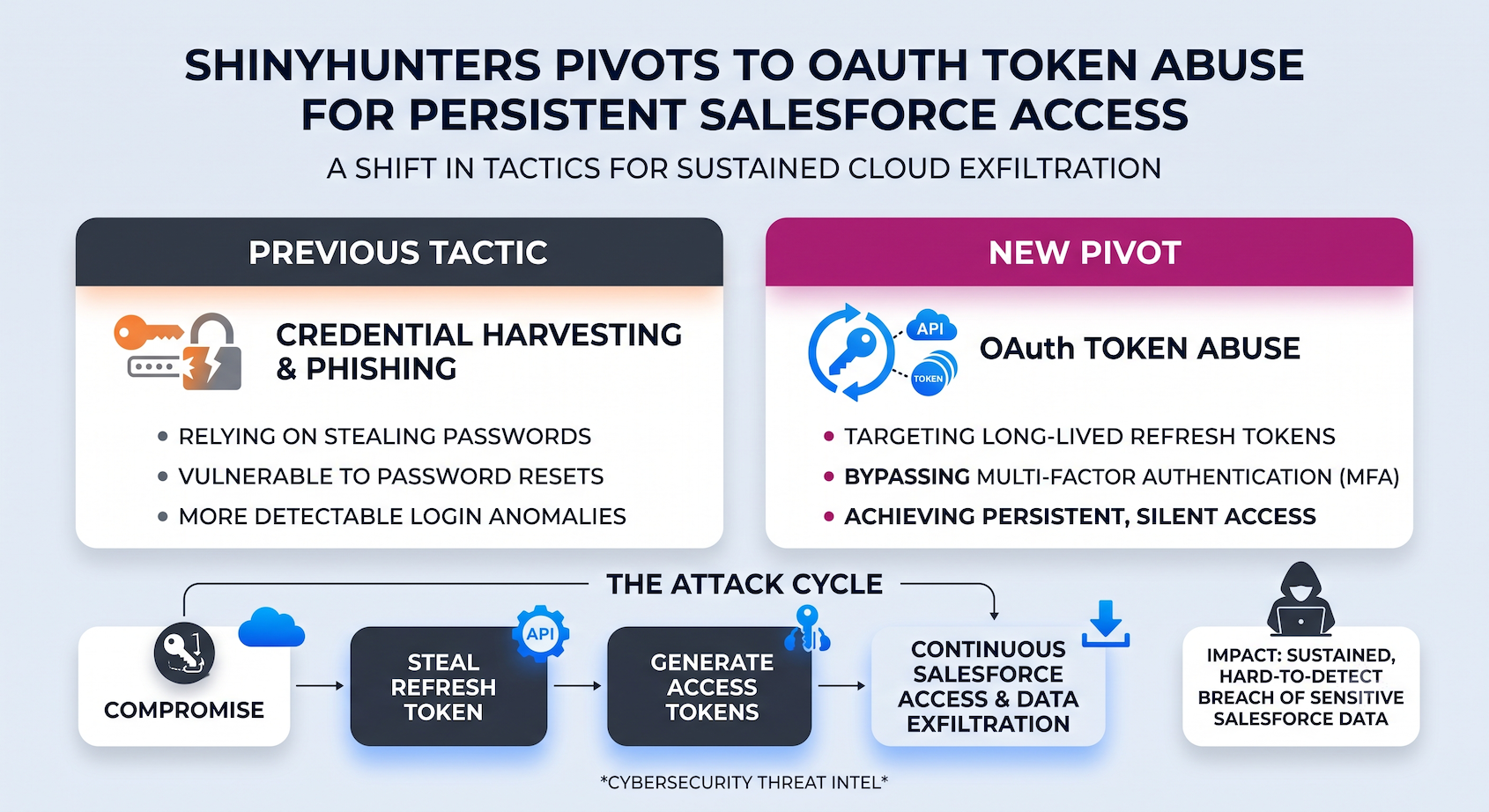
Microsoft issued a warning on July 14, 2026, that ShinyHunters — the prolific threat group behind multiple massive 2026 breaches — has pivoted from direct credential theft to OAuth token abuse for maintaining persistent, stealthy access to Salesforce environments. The technique allows the group to retain long-term access even after initial credentials are rotated or sessions are terminated.
OAuth token abuse works by registering malicious third-party application connections or hijacking existing OAuth grants, allowing attackers to generate fresh access tokens on demand without requiring re-authentication. Because these tokens appear to originate from legitimate connected applications rather than direct logins, they routinely bypass standard identity monitoring, conditional access policies, and MFA requirements. Microsoft’s warning notes ShinyHunters is using this persistence to maintain ongoing visibility into CRM data, sales pipelines, and customer contact records.
The group has been extraordinarily active in 2026, previously linked to the 275 million Canvas student record breach, 25 million Conduent government records, and 26 million MSG Entertainment records. The OAuth pivot represents a maturation of their tradecraft — shifting from high-noise smash-and-grab exfiltration toward quiet, sustained presence in high-value enterprise environments.
Source
Check Point Research — July 13 Threat Intelligence Report
Imperva — Threat Intelligence, July 13, 2026
Commentary
ShinyHunters going persistent via OAuth is a significant tradecraft evolution for a group that built its reputation on volume-based data exfiltration. OAuth abuse in SaaS environments is notoriously hard to detect because the tokens are legitimate by design — they represent authorized application connections. Standard indicators like impossible travel, unfamiliar IPs, or failed logins simply don’t fire when a threat actor holds a valid, auto-refreshing token tied to an approved integration.
Salesforce orgs in particular tend to accumulate dozens of third-party OAuth connections from marketing tools, analytics platforms, and workflow automation services — many with broad data access scopes that are rarely reviewed. For red teams, this is a well-established but underutilized persistence technique worth adding to post-compromise playbooks. For defenders, the mitigation is operationally painful but necessary: audit all OAuth grants, revoke anything not actively in use, restrict token scopes to minimum necessary, and build detection for anomalous API call patterns on existing OAuth connections — particularly high-volume reads on contact, opportunity, or account objects.