

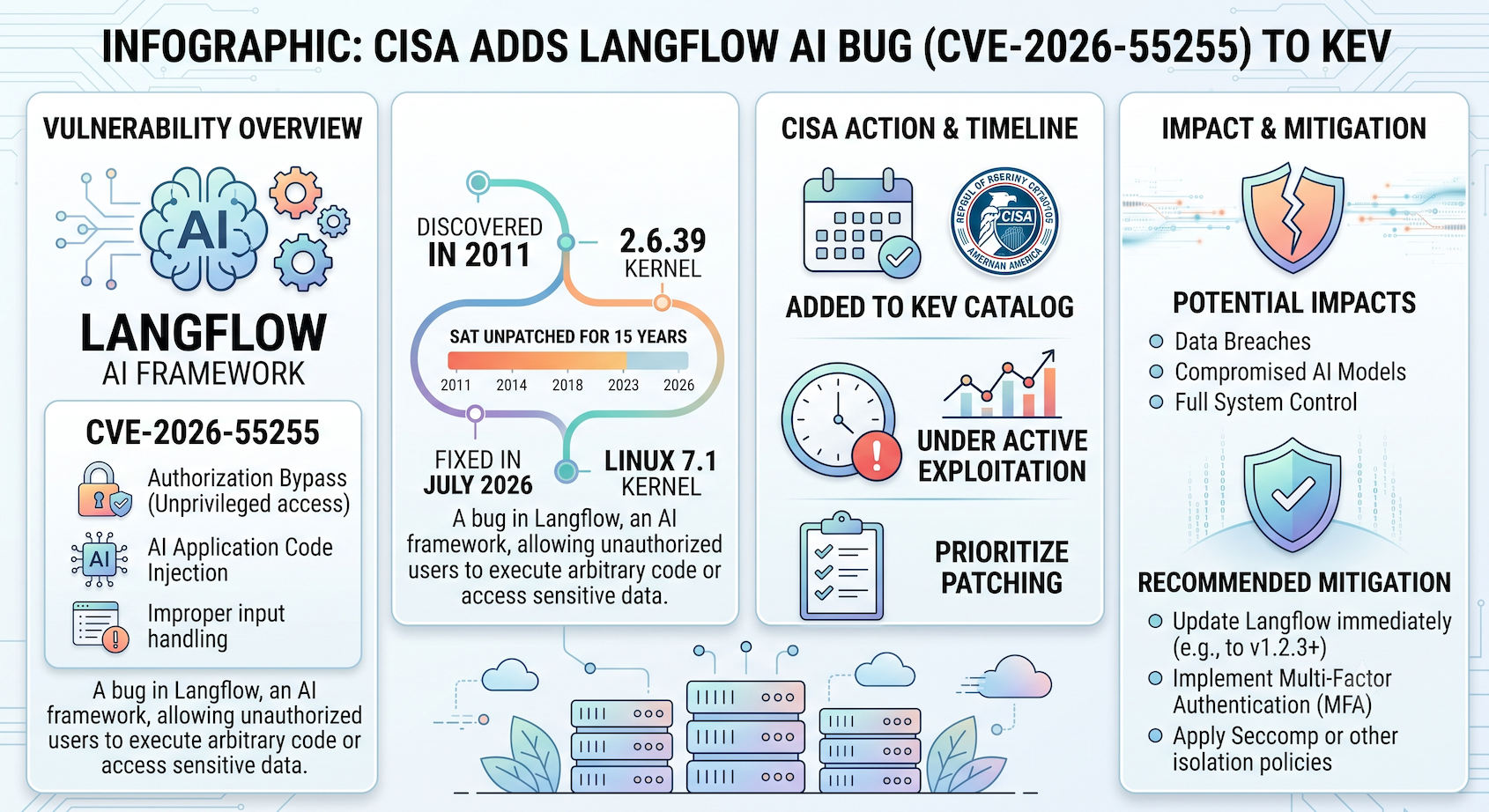
The U.S. Cybersecurity and Infrastructure Security Agency (CISA) added CVE-2026-55255, an authorization bypass vulnerability in Langflow, to its Known Exploited Vulnerabilities (KEV) Catalog in early July 2026, alongside path traversal flaws in Adobe ColdFusion and multiple Joomla vulnerabilities. CISA mandated that U.S. federal civilian agencies remediate all four vulnerabilities by July 10, 2026. Langflow is an open-source framework for building and orchestrating AI agents, widely used by developers to prototype and deploy agentic AI workflows.
The vulnerability allows attackers to bypass authorization controls and gain unauthorized access to Langflow deployments. Active exploitation is confirmed and notable given the framework’s recent profile: a Langflow vulnerability was previously leveraged in the JadePuffer autonomous AI ransomware attack, where an AI agent exploited the flaw to breach a target network, steal credentials, and encrypt a company’s database end-to-end without human involvement. With agentic AI deployments multiplying rapidly across the industry, vulnerabilities in AI orchestration frameworks now represent a new and high-impact attack surface class.
Source: Help Net Security | The Hacker News | CISA Advisory
Commentary: The JadePuffer connection provides critical context here. We’ve now seen at least one documented case of a Langflow vulnerability being exploited in a fully autonomous ransomware attack — and CISA adding CVE-2026-55255 to KEV suggests exploitation is broader than that single incident. With developers spinning up Langflow-powered agent frameworks at scale, the attack surface is growing faster than patching cycles can keep up.
The broader pattern is worth tracking: the AI tooling layer — orchestration frameworks, agent runtimes, API gateways — is becoming a priority target precisely because organizations vetting AI deployments tend to focus on model safety and data privacy rather than hardening the infrastructure running the agents. That gap is exactly what attackers are exploiting. Organizations running Langflow in any capacity should patch to the latest version immediately and audit for signs of prior access.